
by Deyhowähda·dih – Bradley Powless
On July 4, 1776, thirteen American colonies declared independence from King George and his English rule. The colonists reached out the to Haudenosaunee to fight. The Haudenosaunee pledged neutrality and saw this as a fight between “father and son”. After seven years of battles, the English Crown surrendered their rule over the colonies after the battle of Yorktown. The colonies then became independent states with the birth of the United States of America with the signing of the Treaty of Paris on September 3, 1783.
 American Revolution
During the American Revolution, the Haudenosaunee suffered great losses. In 1778, Joseph Brant, a Mohawk supporter of the English Crown, disregarded the pledge of neutrality. He punished colonists who had crossed the King’s 1763 Proclamation Line (a boundary between natives and American colonists). Joseph Brant’s forces raided colonial towns that had crossed the boundary to force them back out of Mohawk lands. The colonists called for vengeance against the raids. General George Washington responded to Joseph Brant’s raids with orders called the Sullivan Campaign.
Sullivan Campaign
George Washington ordered General Sullivan to carry out the “complete destruction” of Haudenosaunee people, towns, orchards, and fields. The Colonial army’s objective to kill, plunder, and burn as many Haudenosaunee people, homes, and crops started in the spring. The army attacked the capital of the Haudenosaunee first, the Onondaga, in April of 1779. For miles, Onondaga homes were set a blaze and men, women, children were killed or taken prisoner.
The surviving Onondaga escaped to sister nations warning them of the colonial army’s intent to destroy everyone and everything. When General Sullivan’s forces attacked the Cayuga and Seneca later that year in August, the army encountered mostly abandoned villages. The army then would spend days eating and plundering as much as they could before burning homes, stores of food, and cutting down orchards.
The Haudenosaunee people that escaped, traveled to Fort Niagara in search of safety, but found none. The British did not let them inside. Haudenosaunee families tried to harbor the winter outside of the fort. But many people who survived the colonial army, did not survive the harsh winter. In the spring, the surviving Haudenosaunee began to rebuild with a gift from the Creator, the Cicada when we had nothing else to eat.
Little Turtle
In 1789, George Washington became the first president of the United States. As Manifest Destiny propelled the United States to want to settle westward, the Indigenous people did not agree that the new country could claim their lands in the Ohio Valley. Little Turtle of the Miami began fighting against the expansion and handed the United States army significant losses in the 1790s. Little Turtle began to reach out to other nations to join his forces to resist the United States. One of those nations was the Haudenosaunee.
President Washington did not want the battle with Little Turtle to expand with more indigenous fighters. He did want a new boundary for the United States and to have access to westward lands. Washington therefore decided to offer a treaty agreement with the people he wanted to destroy just a few years earlier, the Haudenosaunee.
Haudenosaunee Decision
The Haudenosaunee had to decide whether to join a fight against the United States or negotiate a treaty with the United States. The United States wanted a new border and in exchange they would pledge the end of violence, acknowledge the Haudenosaunee as a sovereign, provide a peaceful method to resolve differences, and provide yearly funds to rebuild after the devastation of the Sullivan Campaign.
The Haudenosaunee decided to make a treaty with the United States over joining Little Turtle’s forces to halt the expansion of Manifest Destiny.
The following is the Treaty agreed to by two nations, the Haudenosaunee and the United States.
The Canandaigua Treaty
November 11, 1794
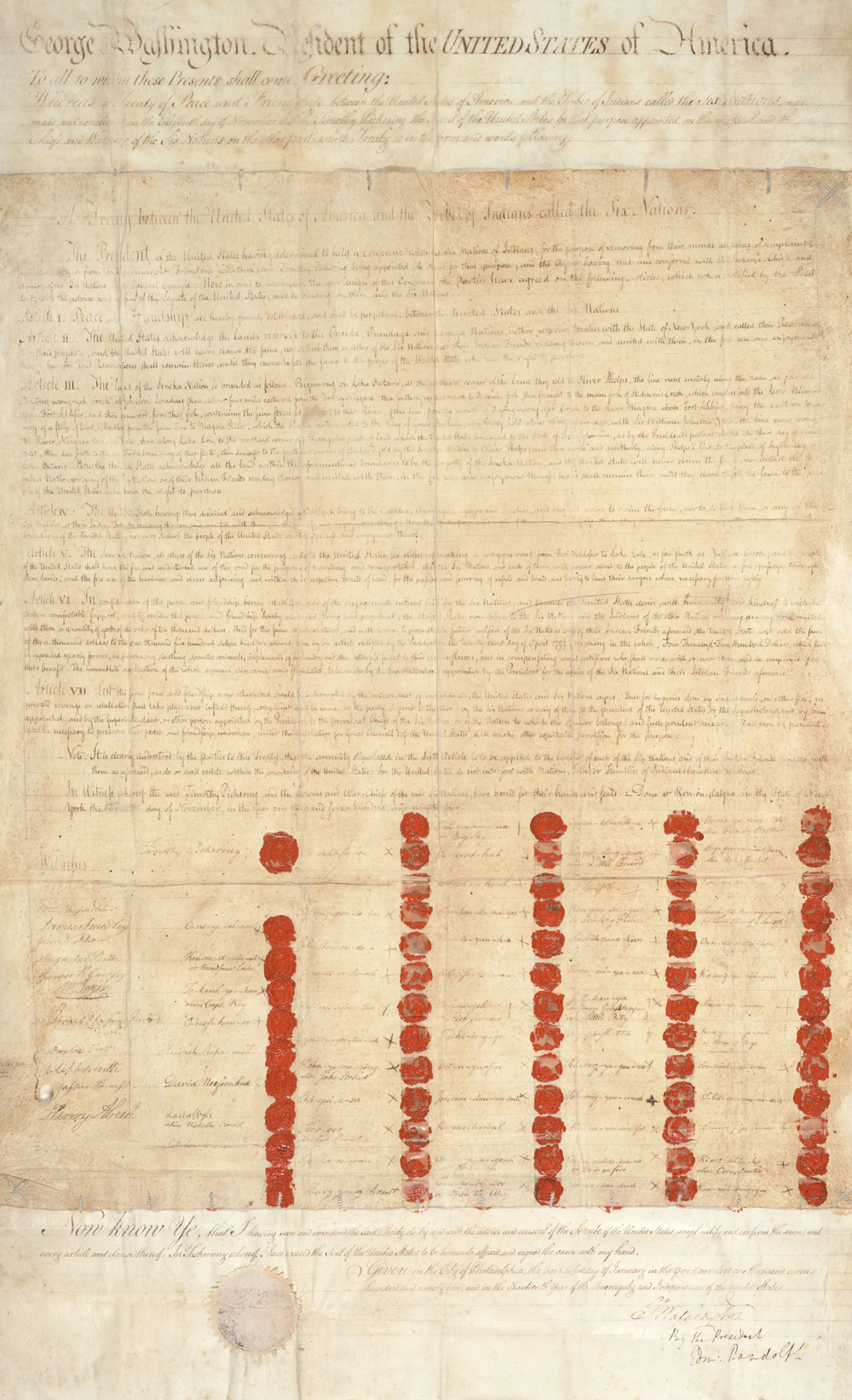
The President of the United States having determined to hold a conference with the Six Nations of Indians, for the purpose of removing from their minds all causes of complaint, and establishing a firm and permanent friendship with them; and Timothy Pickering being appointed sole agent for that purpose; and the agent having met and conferred with the Sachems, Chiefs and Warriors of the Six Nations, in a general council: Now in order to accomplish the good design of this conference, the parties have agreed on the following articles, which, when ratified by the President, with the advice and consent of the Senate of the United States, shall be binding on them and the Six Nations.
Article I. Peace and friendship are hereby firmly established, and shall be perpetual, between the United States and the Six Nations.
Article II. The United States acknowledge the lands reserved to the Oneida, Onondaga and Cayuga Nations, in their respective treaties with the state of New York, and called their reservations, to be their property; and the United States will never claim the same, nor disturb them or either of the Six Nations, nor their Indian friends residing thereon and united with them, in the free use and enjoyment thereof: but the said reservations shall remain theirs, until they choose to sell the same to the people of the United States who have right to purchase.
Article III. The land of the Seneca nation is bounded as follows: Beginning on Lake Ontario, at the north-west corner of the land they sold to Oliver Phelps, the line run westerly along the lake, as far as O-yong-wong-yeh Creek at Johnson’s Landing-place, about four miles eastward from the fort of Niagara; then southerly up that creek to its main fork, then straight to the main fork of Stedman’s Creek, whic
h empties into the river Niagara, above Fort Schlosser, and then onward, from that fork, continuing the same straight course, to that river; (this line, from the mouth of O-yong-wong-yeh Creek to the river Niagara, above Fort Schlosser, being the eastern boundary of a strip of land, extending from the same line to Niagara River, which the Seneca Nation ceded to the King of Great Britain, at a treaty held about thirty years ago, with Sir William Johnson;) then the line runs along the river Niagara to Lake Erie; then along Lake Erie to the north-east corner of a triangular piece of land which the United States conveyed to the state of Pennsylvania, as by the President’s patent, dated the third day of March, 1792; then due south to the northern boundary of that state; then due east to the south-west corner of the land sold by the Seneca nation to Oliver Phelps; and then north and northerly, along Phelps’ line, to the place beginning on Lake Ontario. Now, the United States acknowledge all the land within the aforementioned boundaries, to be the property of the Seneca nation; and the United States will never claim the same, nor disturb that Seneca nation, nor any of the Six Nations, or their Indian friends residing thereon and united with them, in the free use and enjoyment thereof: but it shall remain theirs, until they choose to sell the same to the people of the United States, who have the right to purchase.
Article IV. The United States having thus described and acknowledged what lands belong to the Oneidas, Onondagas, Cayugas, and Senecas, and engaged never to claim the same, nor to disturb them, or any of the Six Nations, or their Indian friends residing thereon and united with them, in the free use and enjoyment thereof: Now the Six Nations, and each of them, hereby engage that they will never claim any other lands within the boundaries of the United States; nor ever disturb the people of the United States in the free use and enjoyment thereof.
Article V. The Seneca Nation, all others of the Six Nations concurring, cede to the United States the right of making a wagon road from Fort Schlosser to Lake Erie, as far south as Buffalo Creek; and the people of the United States shall have the free and undisturbed use of this road, for the purposes of traveling and transportation. And the Six Nations, and each of them, will forever allow to the people of the United States, a free passage through their lands, and the free use of their harbors and rivers adjoining and within their respective tracts of land, for the passing and securing of vessels and boats, and liberty to land their cargoes when necessary for their safety.
Article VI. In consideration of the peace and friendship hereby established, and of the engagements entered into by the Six Nations; and because the United States desire, with humanity and kindness, to contribute to their comfortable support; and to render the peace and friendship hereby established strong and perpetual; the United States now deliver to the Six Nations, and the Indians of the other nations residing among and united with them, a quantity of goods of the value of ten thousand dollars. And for the same considerations, and with a view to promote the future welfare of the Six Nations, and of their Indian friends aforesaid, the United States will add the sum of three thousand dollars to the one thousand five hundred dollars, heretofore allowed them by an article ratified by the President, on the twenty-third day of April 1792; making in the whole, four thousand five hundred dollars; which shall be expended yearly forever, in purchasing clothing, domestic animals, implements of husbandry and other utensils suited to their circumstances, and in compensating useful artificers, who shall reside with them or near them, and be employed for their benefit. The immediate application of the whole annual allowance now stipulated, to be made by the superintendent appointed by the President for the affairs of the Six Nations, and their Indian friends aforesaid.
Article VII. Lest the firm peace and friendship now established should be interrupted by the misconduct of individuals, the United States and Six Nations agree, that for injuries done by individuals on either side, no private revenge or retaliation shall take place; but, instead thereof, complaint shall be made by the party injured, to the other: By the Six Nations or any of them, to the President of the United States, or the Superintendent by him appointed: and by the Superintendent, or other person appointed by the President, to the principal chiefs of the Six Nations, or of the nation to which the offender belongs: and such prudent measures shall then be pursued as shall be necessary to preserve our peace and friendship unbroken; until the legislature (or great council) of the United States shall make the equitable provision for the purpose.
Note: It is clearly understood by the parties to this treaty, that the annuity stipulated in the sixth article, is to be applied to the benefit of such of the Six Nations and of their Indian friends united with them as aforesaid, as do or shall reside within the boundaries of the United States: for the United States do not interfere with nations, tribes or families, of Indians elsewhere resident.
IN WITNESS WHEREOF, the said Timothy Pickering, and the sachems and war chiefs of the said Six Nations, have hereunto set their hands and seals.
Done at Canandaigua, in the State of New York, in the eleventh day of November, in the year one thousand seven hundred and ninety-four.
Timothy Pickering
Witnesses:
Israel Chapin, William Shepard, Jr., James Smedley, John Wickham, Augustus Porter, James H. Garnsey, William Ewing, & Israel Chapin, Jr.
Interpreters: Horatio Jones, Joseph Smith, Jasper Parrish & Henry Abeele
Signed by fifty-nine Sachems and War Chiefs of the Six Nations
Canandaigua, New York — November 11, 1794
O-no-ye-ah-nee, Kon-ne-at-or-tee-ooh (Handsome Lake), To-kenh-you-hau (Capt. Key), O-nes-hau-ee, Hendrich Aupaumut, David Neessoonhuk, Kanatsoyh (Nicholas Kusik), Soh-hon-te-o-quent, Oo-duht-sa-it, Ko-nooh-qung, Tos-song-gau-lo-luss, John Sken-en-do-a, O-ne-at-or-lee-ooh (Handsome Lake), Kus-sau-wa-tau, E-yoo-ten-yoo-tau-ook, Kohn-ye-au-gong (Jake Stroud), Sha~qui-ea-sa, Teer-oos (Capt. Printup), Soos-ha-oo-wau, Henry Young Brant, Sonh-yoo-wau-na (Big Sky), O-na-ah-hah, Hot-osh-a-henh, Kau-kon-da-nai-ya, Non-di-yau-ka, Kos-sish-to-wau, To-he-ong-go, Oo-jau-gent-a (Fish Carrier), Oot-a-guas-so, Joo-non-dau-wa-onch, Ki-yau-ha-onh, Oo-tau-je-au-genh (Broken Axe), Tau-ho-on-dos (Open the Way), Twau-ke-wash-a, Se-quid-ong-guee (Little Beard), Ko-djeoto (Half Town), Ken-jau-au-gus (Stinking Fish), Soo-noh-qua-kau, Twen-ni-ya-na, Jish-kaa-ga (Green Grasshopper, Little Billy), Tug-geh-shot-ta, Teh-ong-ya-gau-na, Teh-ong-yoo-wush, Kon-ne-yoo-we-sot, Ti-oo-quot-ta-kau-na (Woods on Fire), Ta-oun-dau-deesh, Ho-na-ya-wus (Farmer’s Brother), Sog-goo-ya-waut-hau (Red Jacket), Kon-yoo-tai-yoo, Sauh-ta-ka-ong-yees (Two Skies of Length), Oun-na-shatta-kau, Ka-ung-ya-neh-quee, Soo-a-yoo-wau, Kau-je-a-ga-onh (Heap of Dogs), Soo~nooh-shoo-wau, Tha-og-wau-ni-as, Soo-nong-joo-wau, Ki-ant-whau-ka (Corn Planter) & Kau-neh-shong-goo
About the Belt
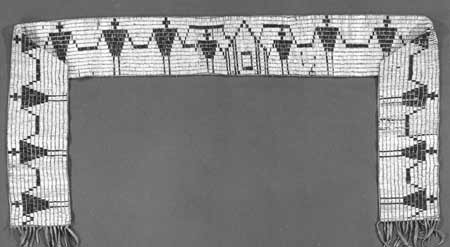
The George Washington Belt is approximately 6 feet in length and 6 inches wide. The center of the belt is an image of the longhouse. On either side are two smaller figures representing Tadodaho and George Washington. On one side of the belt are 7 large figures, 6 large figures on the other. These 13 figures represent the 13 states of the United States. All figures are holding hands representing peace and friendship between the United States and the Haudenosaunee.
