
Birth of a Nation
Five warring people join to become the Haudenosaunee
Over a thousand years ago on the shores of Onondaga Lake, in present day central New York, democracy was born.
The Mohawk, Oneida, Onondaga, Cayuga and Seneca people had been warring against each other. There was great bloodshed and death surrounding us. The people of the five nations had forgotten their original ways and their actions saddened the Creator. The Creator decided to send a messenger to the people so that the five nations could live in peace. The messenger is referred to as the Peacemaker.
The Creator sent a child to a young woman in a dream on the northern shores of Lake Ontario. When she began to show that she was to be a mom, her mother asked who was the father?
The young woman stated that the Creator came to her in a dream that this child was special and would bring peace. Not believing in her daughter, she and her daughter moved away from the village.
After the child was born, the grandmother did not want to return to the village with her daughter saying that the Creator was the father of the baby. The grandmother then tried to get rid of the baby three different times. After each attempt, the grandmother would return to their lodge and to her surprise see the baby in her mothers arms.
The grandmother was now convinced that this shield was indeed special. She then helped raise him in a good way. Right away, he always talked of peace and that he was given a powerful message by the Creator.
When he was ready, the Peacemaker told his mother and grandmother that he was off to bring peace to the warring people across the big lake. To show that his words of peace were true, the Peacemaker carved a canoe made entirely out of white stone!
This amazing feat would convince the people of the powerful message of peace the Creator was sending to the people. He said his goodbyes, and started his journey across the big lake in the white stone canoe.
In order for the Creator’s message to spread, the Peacemaker sought out the most evil leaders of the people of the five nations. In searching for these people, the Peacemaker came upon a woman named Jikonhsaseh. This woman had no alliances but did provide shelter and food and promoted the continuation of the fighting between nations.
The Peacemaker told Jikonhsaseh about the message of peace and that her actions were promoting war and saddening the Creator.
After listening to the Peacemaker’s message, she agreed that this message of peace was strong but needed a form. The Peacemaker told her that the form of peace will take the shape of a longhouse. Under the roof of the laws of peace, each nation will hold their own council fire. Jikonhsaseh agreed to this plan of peace.
She was the first to accept the great p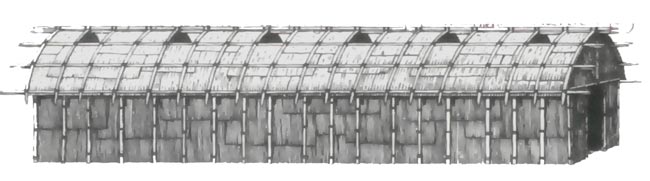 eace and change her ways. Because of this, the Peacemaker set aside a special duty for the women of the five nations. They will have the duty of Clan Mother. The Clan Mother will watch over the members of her clan and counsel them in a peaceful way. The Clan Mother will also have the important duty of selecting the next leader of their clan to keep the great peace continuing on.
The Peacemaker started with the eastern most nation, the Mohawk. In order for his plan to succeed, the Peacemaker sought after the
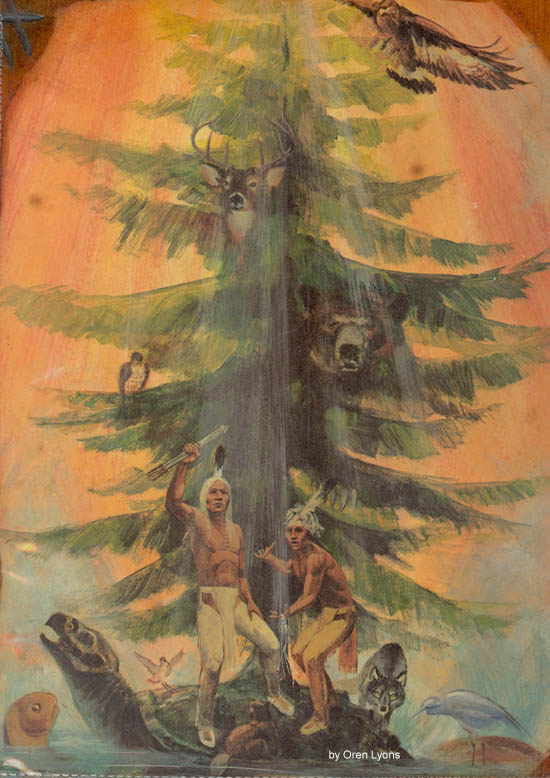
most feared leaders. The Peacemaker explained to them that he carried the Creator’s plan of peace. He explained that one nation standing alone can be easily broken, like a single arrow. But five nations, bound together with one heart, one mind, and one law will be powerful. He then tightly bundled five arrows to show how strong unity can be.
The Mohawks liked his plan but were wary of it being a trap. If they laid down their weapons, they would be attacked. The Mohawks decided to test the Peacemaker. The Mohawks instructed the Peacemaker to climb a tree that overhanged over a large waterfall (now named Cohoes Falls). If he survived, they would accept his plan of peace was indeed sent by the Creator.
Peacemaker climbed the tree and watched as the Mohawks cut the tree and watched the Peacemaker fall over the waterfall. The next day the Mohawks were surprised to find the Peacemaker sitting on the shore by the waterfall. The Mohawks were then the first Nation to accept the peace.
The Peacemaker continued traveling west, seeking out the most evil and dangerous men. The Peacemaker next met the Oneida where he told them of living united under one law in the shape of a longhouse and the strength of five unified arrows. Slowly the peace began to grow as the Oneida accepted the message.
But one of the most feared men of the five nations was an Onondaga man named Tadodaho. Tadodaho was said to be so evil that his body was twisted and snakes grew from his head. Tadodaho defied all talks of peace. He ruled through war and cruelty.
At Onondaga there was another man, his name was Hiawatha. Hiawatha grew tired of the constant warfare and death and longed for a better life. He began to challenge the idea of constant warfare and now wanted peace. Hearing the Hiawatha’s talk of peace, Tadodaho decided something must be done to halt peace. It was then that Tadodaho killed Hiawatha’s daughters. Stricken with grief, Hiawatha no longer thought of peace.
Hiawatha wondered about in his sadness, unable to see how peace could be for him or his people.
Until one day he came upon a lake. As he stood on the shore, the birds sitting on the lake took to the sky and carried the water with them. Hiawatha was able to walk across the lake bottom where he found shiny purple and white shells (wampum). As he gathered the shells, they began to lift his spirits. He then strung the shells together and longed for someone to console him to make him feel better again.
It is at this time that the Peacemaker encountered Hiawatha. Seeing his sadness, he held Hiawatha’s wampum and began speaking kind words to lift his spirits so he could see the gifts of the Creator. His words wiped away his tears, cleared his ears, and cleared his throat of the grief that surrounded him.
Hiawatha, now of a clear mind, was now ready to work with the Peacemaker to spread the word of peace to the five nations. They continued walking west to the Cayuga. The Peacemaker reassured Hiawatha that they would return to confront Tadodaho with their plan of peace.
Once the Cayuga accepted the peace, the Peacemaker and Hiawatha traveled west to the Seneca. The Seneca heard the plan but all could not all agree to accept the peace. To convince the Seneca, the Peacemaker told the Seneca to look to the sky for a sign to know that his words are true.
The Seneca then looked to the sky and witnessed the sun turn black (an eclipse). Seneca then agreed to join the peace.
Once four nations agreed to join in the peace, all that remained was the Onondaga. The Peacemaker, Hiawatha, and the leaders from the other Nations were ready to confront Tadodaho again. Tadodaho tried his sorcerous ways to stop them as they traveled across Onondaga Lake with a fierce storm. But the message of peace was unstoppable and they were able to overcome his storm with a song of peace.
The Peacemaker and the leaders from the other nations then confronted Tadodaho with their plan of peace. Within this plan, the Peacemaker explained that he would have a special duty in this plan of peace. Tadodaho would preside over the Grand Council of 50 chiefs. Accepting this plan of peace, the snakes were combed from his hair and his mind and body made straight.
The Peacemaker explained there will be 50 Hoyane (chiefs); nine chiefs of the Mohawk, nine chiefs of the Oneida, fourteen chiefs of the Onondaga, ten chiefs of the Cayuga, and eight chiefs of the Seneca.
During a Grand Council, the nations will be organized into three benches or parts. The Mohawk and the Seneca will sit together as the Older Brothers on one bench. The Oneida and the Cayuga will sit together on one bench known as the Younger Brothers. T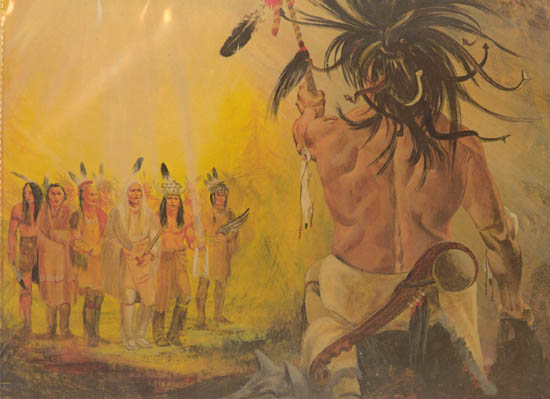 he Onondaga will sit and counsel on one bench known as the Firekeepers. Each bench must come together to decide as one before sending their decision to the other bench. If all three benches agree, the matter that is before the council is said to be decided and that the council has come to One Mind.
Tadodaho, would have the responsibility to make sure that all decisions are to be made with a good mind and were aligned not only for the Haudenosaunee people of today, but for the Seven Generations not yet born.
The Peacemaker then symbolized this union of peace by uprooting a great white pine tree. The white pine tree has 5 bundles of needles to remind the Haudenosaunee of the five nations coming together. All 50 leaders then threw their weapons of hatred, jealousy, anger, and war into the hole, burying their hatchets against each other. A mighty stream washed the weapons away pledging to have peace between the 5 nations as the Peacemaker replanted the Tree of Peace.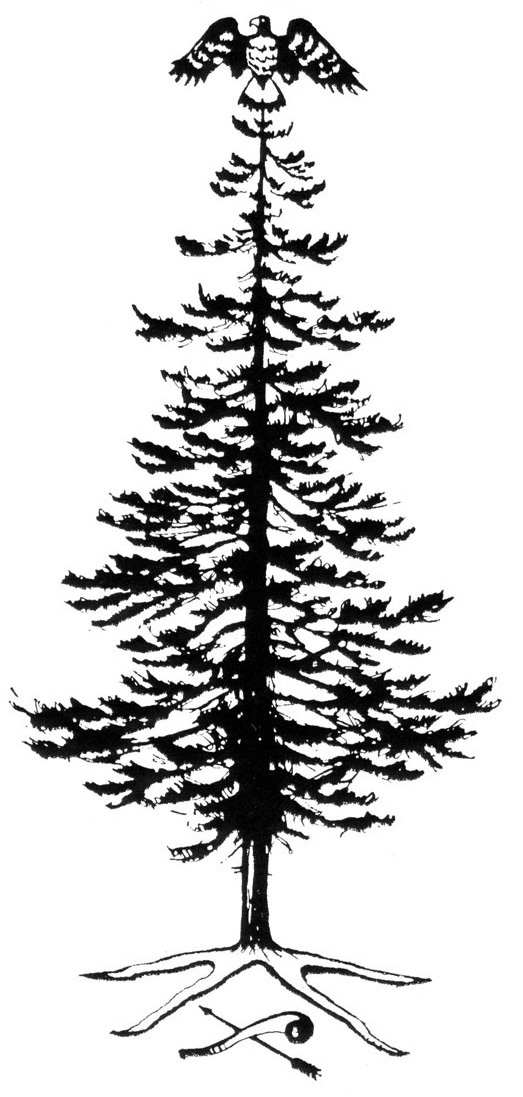
As they replanted the tree, the Peacemaker placed an eagle on top of the Tree of Peace. The eagle is there to use his eyesight to look out far and to warn the Haudenosaunee of any dangers on the horizon to this great peace. If any nation seeks to live in peace, they will follow the roots of the tree of peace and it will lead them to the Haudenosaunee.
A wampum belt was made to record this pledge of peace. It is called the Hiawatha Belt. The belt is made of purple shells with five symbols across the wampum belt. The Hiawatha Belt begins with the path the Peacemaker took bringing peace to the people. The first square symbol is in the east and represents the Mohawk. Next is Oneida. In the center, is the Tree of Peace representing the Onondaga. Next is the Cayuga. And the final symbol in the west is the Seneca. All the nations will be joined together as one.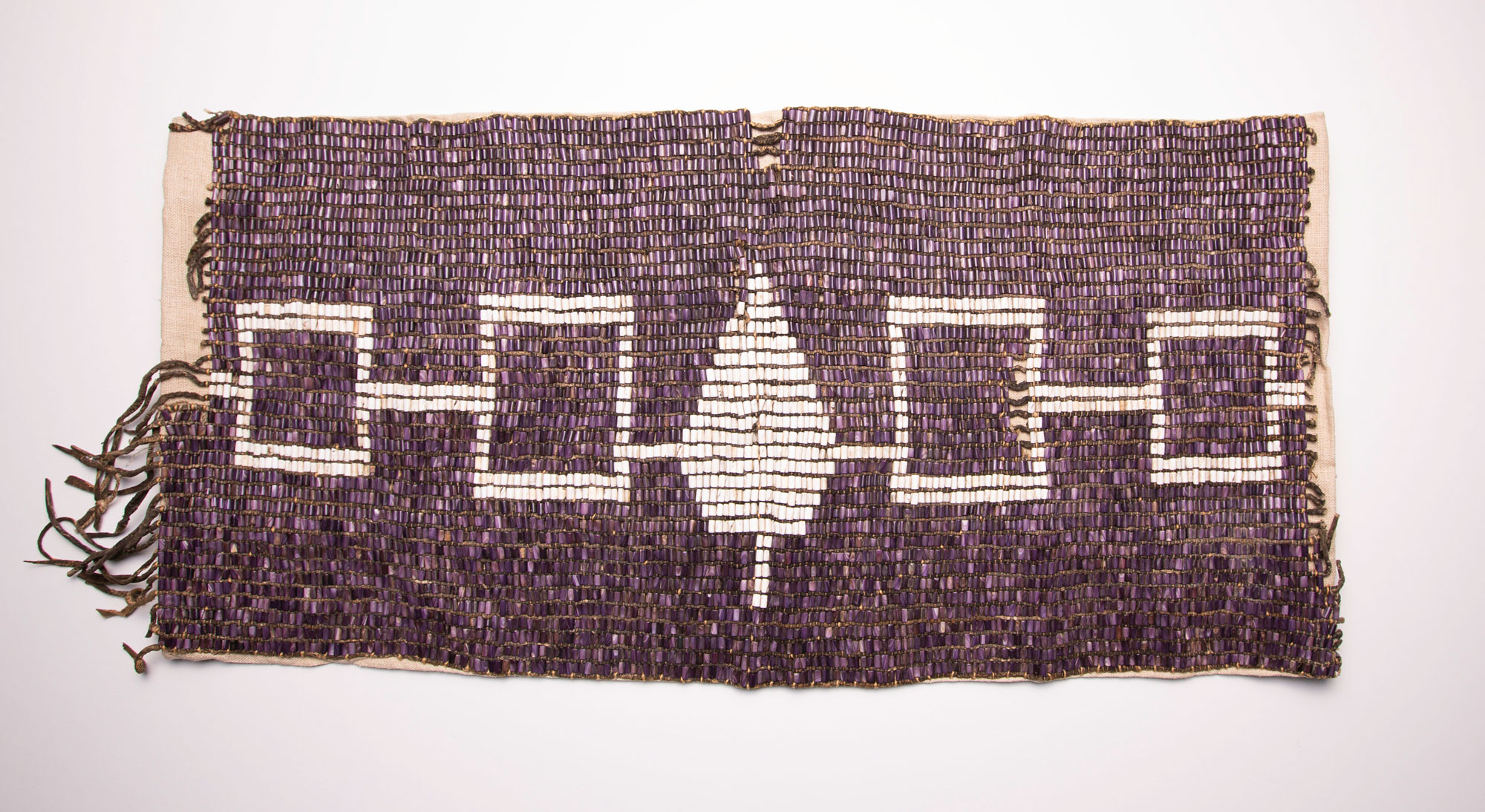
The Peacemaker now instructed the nations to live as if we have One Dish and One Spoon. There will be no blood shed among us as we all share in the gifts the Creator has provided for us and we will no longer eat with no sharp objects between us.
We were now all united in peace and have remained that way for countless centuries.
Read more History – RELATIONS WITH OUR BROTHERS: 1613 to Today