

A lifetime of letters, documents and photographs from a global Haudenosaunee diplomat will be made available to scholars, at SU.
Central Current
By Sean Kirst
Oren Lyons, joined by a helpful nephew, made a stop not long ago at a log cabin where Lyons used to live, on the Onondaga Nation. To get there requires going “up in the woods,” Lyons said, and it had been so long since he revisited the place that the path to the front door was covered with tall grass.
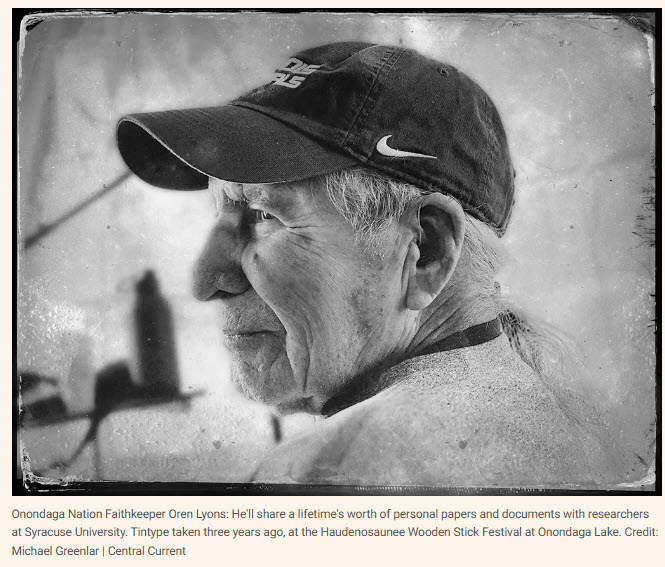 He was there on a quest: As part of an extraordinary “joint stewardship agreement,” Lyons — now 95 — is turning over a lifetime’s worth of letters, notes, documents, artwork and photographs to the Special Collections Research Center at the Syracuse University Libraries.
Those items — significant in volume, to put it mildly — ended up packed away at many places around the region, leaving Lyons and his friends to seek them out. At the old cabin, where the late Bill Moyers once interviewed Lyons, the Onondaga faithkeeper pushed open the door and walked over to a stack of cardboard boxes, stuffed with papers. He picked up a crinkled, water-stained document that happened to be on top.
It was a letter to Lyons sent roughly 40 years ago, by then-President Ronald Reagan.
“I’m a pack rat,” said Lyons, always reluctant to throw anything out — a trait that in this case is a gift to all of us. SU Chancellor Kent Syverud — who is stepping down at the end of this scholastic year after serving since 2014 in the university’s top job — puts it this way:
Lyons, Syverud said, “has had the most amazing life of any alumnus I’ve ever met in terms of the history he’s been involved with and the role he’s played in it.”
The chancellor and Lyons speak of each other as longtime friends. There is no doubt, they both say, that the warmth of their connection helped lead to an agreement that will be celebrated today with a noon ceremony on campus.
Syverud recalls — shortly after his arrival at SU — how he met legendary Syracuse lacrosse coach Roy Simmons Jr., who offered an immediate piece of advice:
Oren Lyons, Simmons’ old friend and a lacrosse teammate in the 1950s, was a guy Syverud should know.
Both Lyons and Syverud said the foundation for that relationship was set down by Syverud’s predecessor as chancellor, Nancy Cantor, who oversaw the 2005 creation of the “Haudenosaunee Promise” program — which provides sweeping SU scholarships to any qualifying students from within the Six Nations.
“That opened the door for us,” Lyons said. He saw that gesture as a significant bridge to the Onondagas, who hadn’t always felt that sense of welcome from the university — and Lyons was pleased when Syverud made an effort to sustain the bond strengthened by Cantor.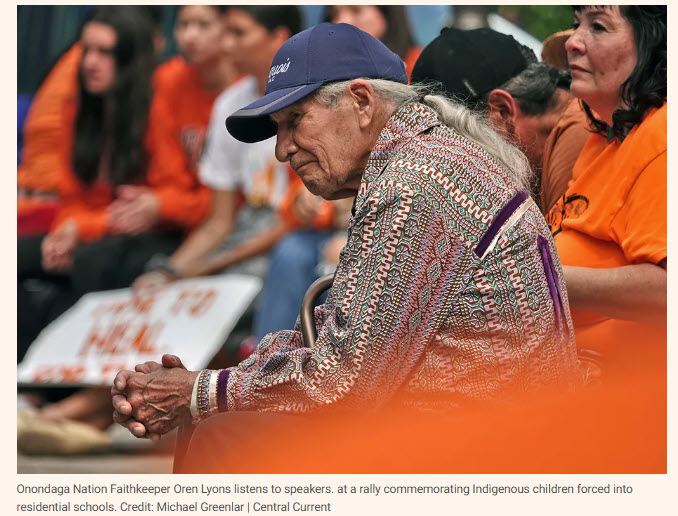
“He’s been terrific,” Lyons said of Syverud. Over the years, they’d “get together a lot,” Lyons said, often for meals at the chancellor’s residence that would include Ruth Chen — an SU professor and the chancellor’s wife — as well as Simmons.
At some point, based on that kinship, they began talking about the need to find the right spot for Lyons’ papers.
Along with Betty Lyons of the American Indian Law Alliance, they were central to the negotiations that led to SU becoming caretakers for the papers. In the most critical part of the arrangement, an agreement was struck for Lyons, his family and the Onondaga people to retain actual ownership of the collection.
Arnold and Seaman said skilled researchers and archivists will soon begin sifting through all the documents, and anything of sacred meaning — or involving topical legal or diplomatic importance — will immediately be returned to the nation. Oren’s son Rex and Sid Hill — the spiritual leader, or Tadodaho of the Haudenosaunee — will be deeply involved in those decisions.
That will still leave a vast assortment of correspondence, documents, images and artwork at SU, a collection Arnold predicts will be of enduring importance to scholars and researchers.
“He’s been almost everywhere and he keeps everything,” Arnold said of Lyons. “I challenge anyone to think of another Native American diplomatic leader who has been so at the forefront (over the past 75 years) of so many transformative moments.”
The breadth of that history is staggering, Arnold said. It runs parallel to a sweeping Indigenous movement to reassert cultural rights and distinct identity after centuries of losing all too much. Lyons calls himself a “runner,” meaning an emissary sent to historic flash points either by Onondaga leadership or by the Haudenosaunee Grand Council.
“The people Oren is connected with and knows are remarkable,” Arnold said, “and it’s all in these papers. People will be using this collection for generations.”