

Syracuse.com
By Glen Coin
Syracuse, N.Y. – High levels of mercury have been found on the east side of Onondaga Lake, an unwelcome surprise that poses troubling questions about whether mercury contamination in parts of the lake is worse than previously believed.
Onondaga County detected mercury in every sample taken last fall from the bottom of the Onondaga Lake Park Marina, which the county plans to expand and renovate. Despite decades of testing and a cleanup of hundreds of acres of the lake bottom, there’s no record of testing in the marina until now.
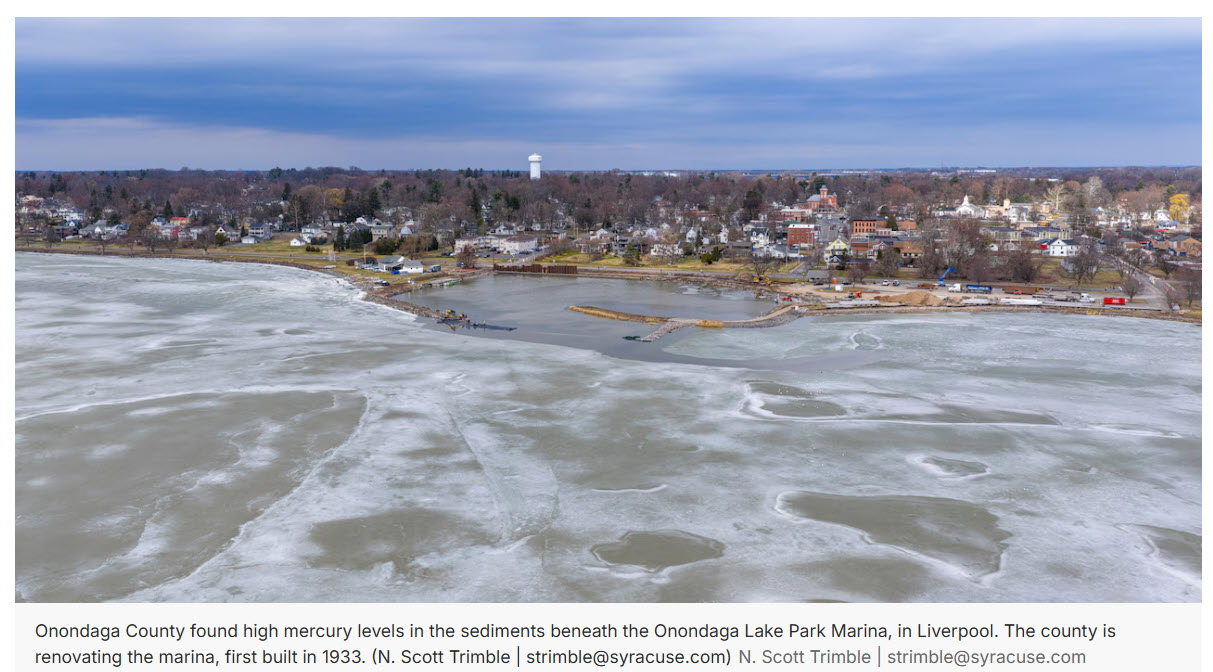
The mercury at the bottom of the marina presents virtually no direct danger to people.
The discovery of mercury there, however, is a reminder that the legacy of decades of industrial pollution continues to haunt the urban lake.
It also raises the question of how much mercury remains to be found even after a half-billion-dollar cleanup project was declared done a decade ago.
the lake’s long history of industrial contamination say they’re not shocked that some mercury was found at the marina, despite continued testing in other parts of the lake since the cleanup ended in 2016.
But they didn’t expect to find the levels so high there, inside Onondaga Lake Park about two miles from the main source of mercury pollution.
“I would have expected a kind of low-level mercury contamination there, but I’m surprised it’s that high,” said Don Hughes, a chemist and local advocate who has been involved in lake testing.
“It’s a little disconcerting,” said Charles Driscoll, a Syracuse University environmental engineering professor who has studied mercury in the lake and around North America.
Testing done in the 1990s and early 2000s showed low levels of mercury near the marina, the state’s Department of Environmental Conservation said. The DEC oversaw the lake cleanup and continues to monitor ongoing testing of the creatures and the water they live in.
But all that testing bypassed the marina itself, said Alma Lowry, an environmental lawyer who works for the Onondaga Nation.
“Nobody’s ever sampled in the marina,” she told syracuse.com | The Post-Standard. “They sampled outside it, but they’ve never sampled within it.”
DEC and the county said they don’t know how the mercury got into the marina.
“The origin of the elevated mercury in the marina basin sediment is unknown,” said a statement from DEC spokesman Bryan Chambala.
Experts and advocates have several theories about what is going on.
Driscoll speculated that mercury in the lake from Allied could have migrated and then accumulated in the sheltered waters of the marina, which was built in 1933. It’s also possible that some mercury could have come from old paints used in the past to help cover boat hulls, he said.
It’s been known for decades that the southwestern corner of the lake was heavily contaminated with mercury dumped by Allied Chemical. From the 1940s to 1970 Allied dumped about 165,000 pounds of mercury into the lake.
In the 1990s and 2000s, Honeywell, which had merged with Allied, tested sediments around the lake for mercury and other toxic chemicals. The highest concentrations were found in the southwestern corner of the lake, where Allied had been located. Mercury had been detected near the marina, but at low levels.
The entire lake was declared a federal Superfund site in 1994.
In 2005, the DEC ordered Honeywell to clean up tons of mercury on the west side of the lake, opposite the marina. Honeywell dredged more than 2 million cubic yards of muck from the lake bottom and covered 475 contaminated acres with a sand mixture. That work was declared complete in 2016.
The higher mercury findings at the marina raise the specter of a more widespread problem. In a letter to the DEC this month, Lowry said the state should order more extensive testing of the lake bottom based on the marina results.
“The Nation is concerned about the implications of this unexpected discovery of elevated mercury levels in an area of the lake presumed to be relatively clean,” Lowry wrote. DEC, she said, should do more testing of the lake bottom “to determine if these unexpected mercury exceedances are an isolated problem or a sign of a larger issue.”
Honeywell is required to test the water and sediments on the portion of the lake it cleaned up, and to catch fish and measure the chemicals in their flesh. DEC said testing conducted near the marina in 2000 and again in 2021 showed mercury levels below the cleanup threshold.
The mercury contamination in the marina came to light only because the county needed state approval to expand the marina. The county applied to DEC last June for permission to renovate and expand the marina.
The county plans to replace the crumbling retaining wall, adding dozens of new slips for boats, upgrading bathrooms and expanding the parking lot. The work is expected to be completed this year.
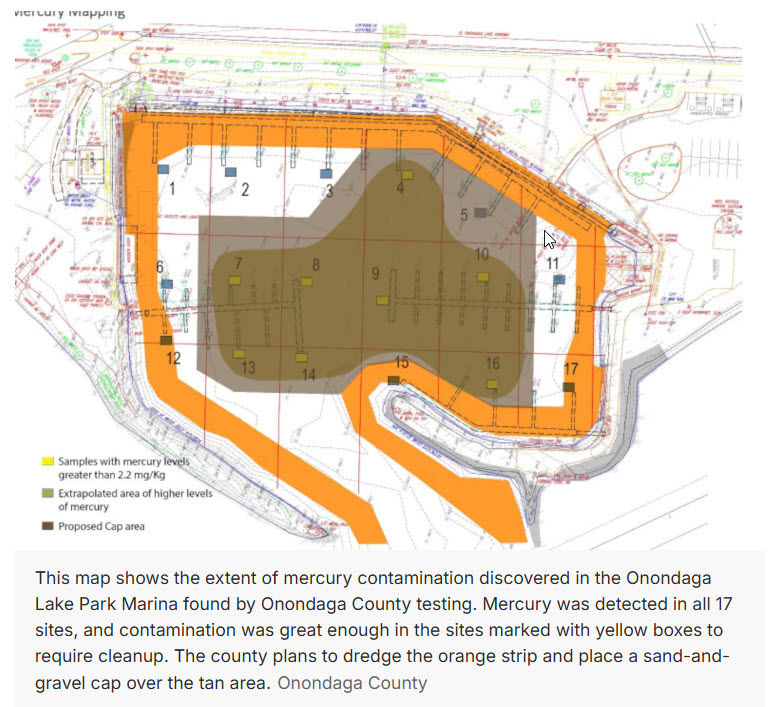
The original testing submitted by the county last fall did not measure the amount of mercury in the sediment. DEC told the county to do more tests, and those found that all 17 test sites in the marina showed evidence of mercury. Mercury levels in eight of those samples were high enough that the county must now conduct a small-scale cleanup similar to the big one Honeywell did on the other side of the lake.
The public never saw last year’s testing results during the short public comment period on the marina expansion project, which was held over the Christmas holidays. The public comment period ran from Dec. 17 to Jan. 2, but the county didn’t provide the mercury tests to DEC until Dec. 22.

Under the original lake cleanup order, the county is required to dredge or cover any area where mercury levels are at least 2.2 parts per million (ppm). The highest level found in the marina was 5.7 ppm, the county said.
For the marina project, the county has proposed dredging about 300 dump trucks worth of sediment from the lake bottom and hauling it to an approved landfill. After that sediment is removed, the county would cover a 2-acre section at the center of the marina with a 1-foot-thick layer of sand and gravel. That cover, similar to the one Honeywell laid on the other side of the lake, is designed to keep in place the contaminated sediments left behind after the dredging.
DEC said it is reviewing that plan. The Onondaga Nation is urging the DEC to delay approval until it conducts more studies and holds a public hearing.
No public hearing or comment period is scheduled on the proposed marina cleanup. A DEC fact sheet says that DEC and state health department officials “are available to answer questions from the community,” but both refused to answer questions from syracuse.com.
The cleanup will cost the county about $1.4 million, said Justin Sayles, spokesman for County Executive Ryan McMahon. The marina expansion project will remain within its $13.7 million budget because other costs have been lower than expected, Sayles said.
Sayles said there are no plans for expanded testing in the lake.
“No additional testing outside of the boundaries of disturbance for the rehabilitation of the Onondaga Lake Park Marina is planned or expected,” he said in an email.
The DEC said it has no plans to require more testing right now.
“If ongoing or future monitoring indicates a potential concern, then additional sampling would be performed,” Chambala said.